Collect and Recycle

Fully Compliant Service
Environmentally Responsible
Clear Digital Documentation
Reliable Collection Service

Solar Panel Recycling For Businesses

We offer solar panel recycling services for businesses with large volumes of materials.
Our collections cover the whole of the UK for commercial solar panel waste.

Compliance

We ensure your solar panel waste is handled in full accordance with current UK regulations, giving your business complete peace of mind. Our processes meet all environmental and waste-management standards, with recycling documentation provided.

Sustainability

Our service is designed to minimise environmental impact by ensuring solar panel materials are recycled safely. Wherever possible, we prioritise reuse, responsible redistribution, and recycling to divert materials from landfill.

Service

We provide a dedicated point of contact and a dependable service. We can collect multiple waste types in a single collection, helping to deliver both cost and environmental savings.

SOLAR PANEL DISPOSAL

Recycling Solar Panels For Businesses UK-Wide

At Collect & Recycle, we provide professional, responsible services for recycling solar panels for businesses. Whilst renewable energy and solar technology are improving sustainability, its key to ensure this extends to its disposal methods. Our recycling service is designed to support businesses in safely managing their end-of-life panels. This can then align with environmental goals and producer compliance schemes.

Whether you are a solar panel installer, manufacturer or construction business, we can help dispose of your solar energy waste safely. We can also collect a range of solar equipment including packaging, rack systems, inverters, cables, and transformers.

Contact

Contact our team regarding the type of solar panel, inverter or battery you need collected. Please include details on the quantity, material, location and contact details.

Collection

We will then provide you with a quote for your waste collection. Our team can then arrange a collection day to suit your businesses schedule.

Recycling

Our specialist waste carriers will then transport your solar panel waste to licensed recycling facilities for repurposing.

Our Duty of Care

You can access all of our duty of care documentation by using the button below. This includes waste exemptions, insurances and waste carriers license.

Receive A Quote

Please fill out the form regarding your enquiry, and one of our
friendly team members will get back to you within 24 hours.

Images of Waste /
MSDS

The Recycling Process For
Different Types Of Solar Panels

We specialise in recycling solar panels for businesses across the UK.
This includes unwanted and end of life solar panel recycling such as:

Silicon-Based Solar Panel Recycling

Silicon-based panel recycling begins with manual disassembly to remove the aluminium frames and junction boxes. The aluminium frame is 100% reusable.

The panels will undergo thermal processing to separate glass from plastics. Silicon is the most common semiconductor material used in solar cells.

Thin-Film Solar Panel Recycling

Initially, the panels are shredded to break them down. This helps in separating the different layers and removes the lamination. To separate the solids and liquids, they are fed through a rotating screw.

The components are finally placed in chemicals to remove the film, and separated through vibration. The glass can then be reused, with the remaining materials dried, separated and processed.

Preparing Solar Panels For Collection

Unity

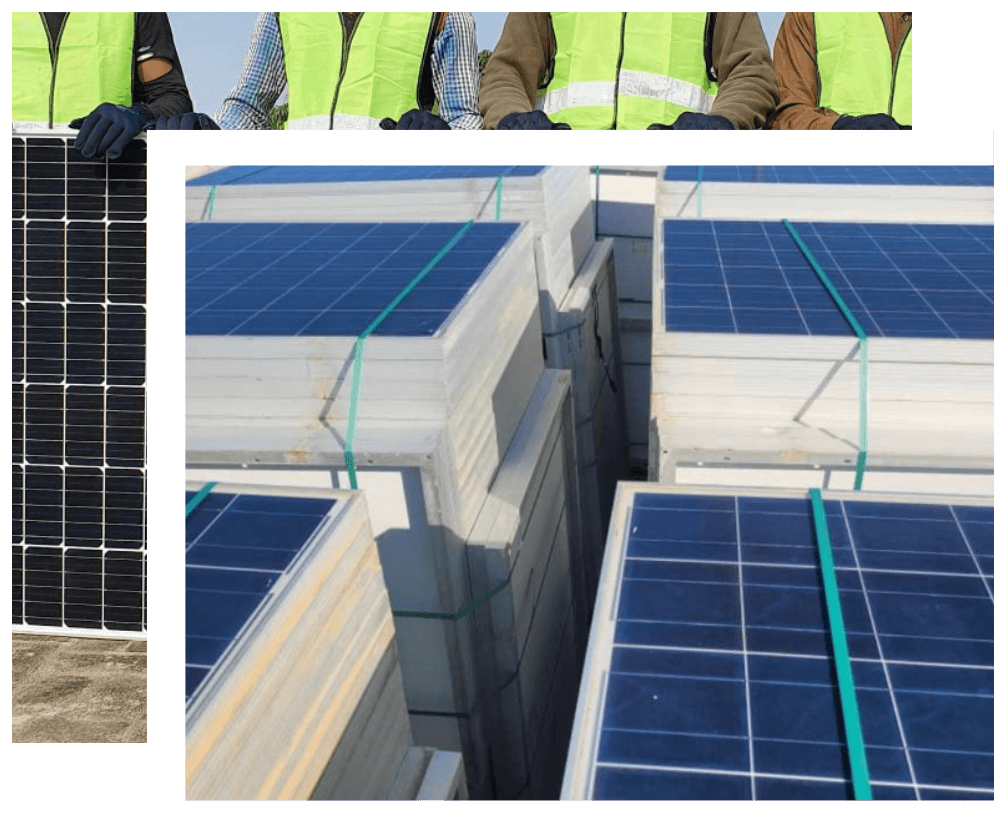
Your PV panels must be unified when stacked on pallets. Please ensure the waste is secured and inline for a safe, efficient collection.

Security

When securing your panels, use a strong strapping that is tied over the panels. This will hold them in place and eliminate the risk of panels falling during loading and transportation.

Height

You should not stack more than 25-30 panels per pallet. This again ensures that your panels maintain their form for loading and removing the waste.

Solar Inverter Recycling

Solar inverters play a vital role in converting the energy generated by solar panels into usable electricity. When inverters reach end-of-life, they often contain valuable components such as aluminium, copper, and electronic circuitry that can be safely recovered. Our specialist solar inverter recycling service ensures these units are dismantled responsibly, diverting waste from landfill and maximising material recovery.

Tranformer Recycling

Transformers used in larger-scale solar installations also require proper end-of-life management. Containing metals, oils, and other components, these units must be processed with care to avoid environmental harm. We provide a compliant transformer recycling solution for businesses across the UK, ensuring safe handling, removal, and recycling of materials wherever possible. 

solar panel recycling

SOLAR MODULE RECYCLING

Book A Collection For Your Solar Panel Recycling

Ready to responsibly recycle your solar panels? Contact Collect & Recycle today to book a collection. Our team is equipped to handle various types of solar panels, ensuring that your solar panel recycling needs are met with professionalism and efficiency.

Simply fill out the form on this page or message us using our online chat to receive a quote. We will get back to you shortly to arrange an efficient collection of your recyclable materials. We also specialise in recycling various other waste types, including cardboard, paper and hazardous materials.

FAQs
Frequently Asked Questions

The recycling process for solar panels involves several steps. Firstly, the aluminium frames are removed. The panels undergo thermal processing to separate the glass and silicon cells. The materials are then processed further to extract valuable raw materials like silicon, which can be reused in new solar cells.

The cost to recycle solar panels varies based on factors like the volume, type of solar panels, and logistics. We offer competitive pricing and work closely with businesses to provide cost-effective recycling solutions. Contact us for a tailored quote.

After 25 years, the efficiency of solar panels typically decreases, although many panels remain functional beyond 30 years. Once they reach the end of their useful life, it’s crucial to recycle them to recover valuable materials and prevent environmental harm.

The scrap value of solar panels depends on the materials recovered, such as aluminium and silicon. While the value varies, the primary benefit of recycling is environmental conservation.

Following waste prevention as the most preferred method in the waste management hierarchy, we apply the WEEE directive to discarded electrical waste. If your panels can be given a new lease of life, our team will focus on saving the panel and its materials for reuse before recycling.

This is the most environmentally-friendly solution as we can save raw materials in the production of new panels, whilst treating your waste sustainably. This is what sets us apart from other businesses, and allows us to create a circular approach to managing waste, minimising your carbon footprint.

One of the primary advantages is the conservation of raw materials. Solar PV panels contain valuable materials like silicon and aluminium, which can be reclaimed and reused. This process significantly reduces the need for extracting raw materials, thereby conserving natural resources and reducing the environmental footprint associated with mining and processing.

Another crucial benefit is the reinforcement of the sustainability of solar power as a renewable energy source. By recycling old or damaged panels, we extend the life cycle of the materials used, thereby enhancing the overall eco-friendliness of solar power.

Efficient waste management is also a key advantage. As the adoption of solar power grows, so does the need to manage end-of-life panels. Recycling facilities provide an environmentally responsible solution for handling this waste, preventing it from ending up in landfills and causing potential environmental harm. This aspect of recycling is especially crucial given the increasing focus on sustainable waste management practices across industries.